

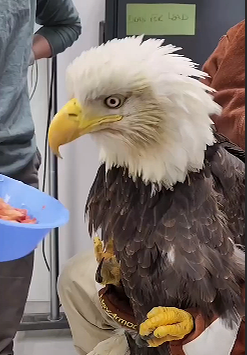
On a quiet countryside road, a family was driving home when something unusual caught their eye. In the middle of the asphalt lay a large eagle, wings spread awkwardly, completely still. At first, they thought it was already gone. But as they slowed down and stepped closer, they noticed the bird’s chest moving ever so slightly.
The eagle was alive—but barely.
Cars passed by without stopping, and the bird was too weak to move out of the way. The family knew that if they left it there, it wouldn’t survive the day. Carefully, they approached, speaking softly so they wouldn’t startle it. The eagle didn’t resist. It was exhausted, dehydrated, and possibly injured.
Using a thick jacket, they gently lifted the bird and placed it in a cardboard box in the back seat. The children watched quietly, worried but hopeful. Instead of going straight home, the family drove to the nearest wildlife rescue center.
At the center, volunteers quickly took the eagle in. After a brief examination, they discovered it was severely dehydrated and had a minor wing injury, likely from a collision or long flight without food. With fluids, rest, and proper care, the eagle slowly began to recover.
Days turned into weeks. The once-weak bird regained its strength. Its feathers looked healthier, its eyes brighter, and its wings powerful once again.
When the day of release finally came, the family was invited back. They stood in an open field as the rescue team opened the crate. For a moment, the eagle stayed still, as if taking in the sky. Then, with a strong beat of its wings, it lifted into the air.
Higher and higher it soared, disappearing into the blue.
The children smiled, and the parents felt a quiet sense of pride. They hadn’t planned to become heroes that day—but by stopping for one helpless creature, they gave it a second chance at life.
Sometimes, saving one life doesn’t change the whole world…
but it changes the whole world for that one life.